
For many facilities, cooling towers are essential for maintaining building comfort and supporting critical operations. What many facility managers don't realize, however, is that their cooling tower could be creating an opportunity to reduce utility costs.
In many municipalities, sewer charges are calculated based on the total amount of water entering a building. The assumption is simple: if water comes into the facility, it eventually leaves through the sewer system.
But that isn't always the case.
For buildings with cooling towers, a significant portion of water is lost through evaporation and never enters the sewer system at all. As a result, many facilities may be paying sewer fees on water they never actually discharge.
Fortunately, there may be a solution.
Understanding Sewer Rebates for Cooling Towers
Many municipalities offer sewer rebates, sometimes called evaporation credits, for facilities that can demonstrate a portion of their water consumption is lost to evaporation rather than discharged to the sewer.
Because cooling towers operate by evaporating water to remove heat, they are often excellent candidates for these programs.
The challenge is proving how much water is evaporated versus how much is discharged. That's where understanding your cooling tower's water use becomes important.
How Cooling Towers Use Water
Cooling towers reject heat by allowing a portion of water to evaporate into the atmosphere. While this process is highly effective, it also changes the concentration of minerals remaining in the system.
As water evaporates:
- Water leaves the system as vapor
- Minerals remain behind and become more concentrated
- Some water must be discharged, or "blown down," to prevent excessive mineral buildup
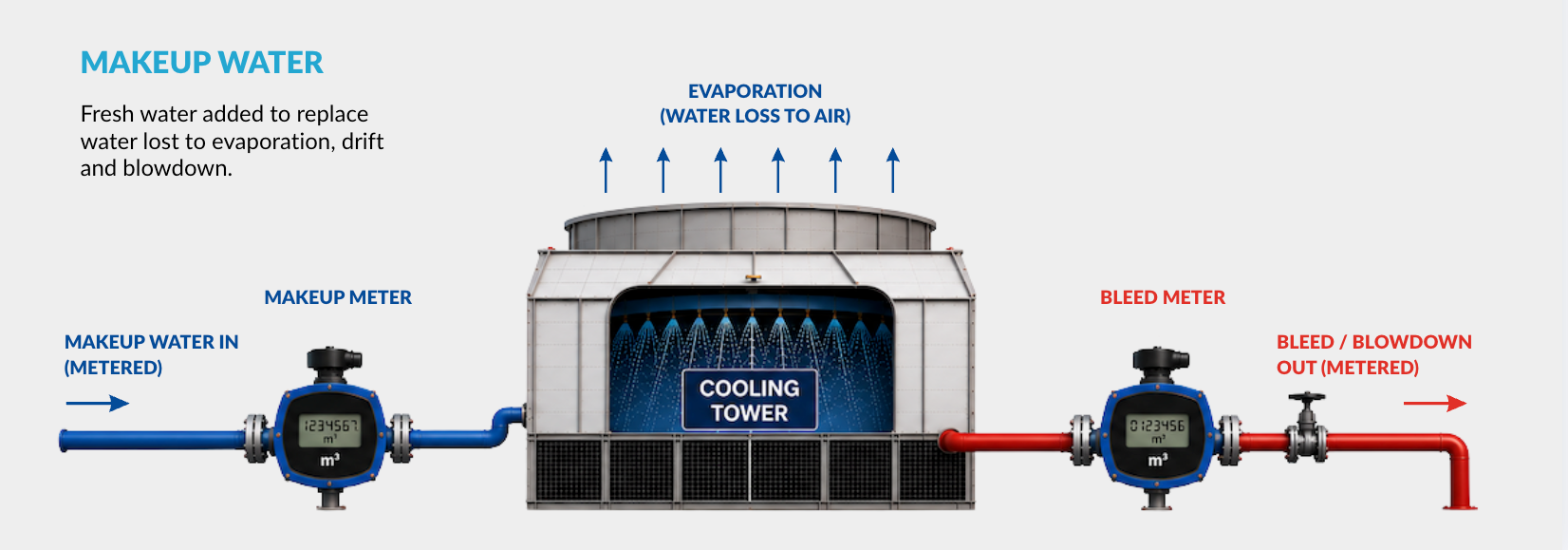
- Fresh makeup water is added to replace water lost through evaporation and blowdown
In many systems, evaporation accounts for the majority of water loss. In fact, it is common for evaporation to represent up to 80% of total water use within a cooling tower system.
The Importance of Cycles of Concentration
One of the key performance indicators for cooling tower operation is cycles of concentration. Cycles of concentration measure how efficiently water is being used before it is discharged from the system.
The basic formula is: Cycles of Concentration = Makeup Water ÷ Bleed Water
Generally speaking, higher cycles mean less water is discharged and more water is used efficiently. However, there is a balance to be achieved.
Running too few cycles can result in excessive water consumption and unnecessary sewer costs. Running too many cycles can increase the risk of scale formation, corrosion, and operational issues that impact system performance. Finding the right balance helps facilities optimize water efficiency while supporting potential sewer rebate opportunities.
The Financial Impact Can Be Significant
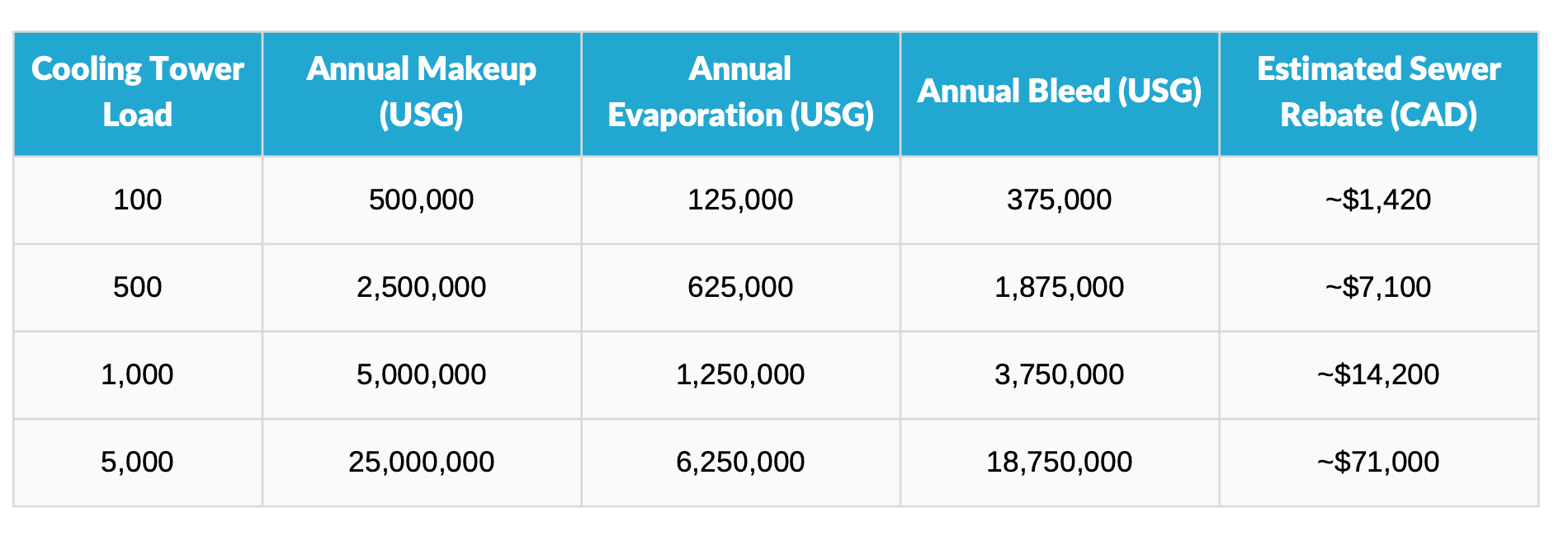
The amount of water lost to evaporation is directly related to cooling load. As a general rule, cooling towers evaporate approximately 1.8 gallons of water per hour for every ton of cooling. Over the course of a year, those losses can add up quickly.
For larger facilities, evaporation losses can represent millions of gallons of water annually. Since that water never enters the sewer system, facilities may be eligible for substantial rebates when proper monitoring and documentation are in place.
Even mid-sized cooling tower systems can generate thousands of dollars in annual savings depending on local wastewater rates and municipal rebate programs.
What Is Required to Qualify?
While requirements vary between municipalities, most programs require facilities to provide reliable documentation of cooling tower water usage.
This often includes:
- A makeup water meter installed on the cooling tower supply line
- A bleed or blowdown meter installed on the discharge line
- Ongoing tracking and recordkeeping of water usage
- An engineering report prepared and certified by a Professional Engineer through a Certificate of Authorization (CoA) designated engineering firm
Without accurate metering and documentation, it can be difficult to demonstrate eligibility for a rebate.
How WMC Water Can Help
Many facilities are unaware that sewer rebate opportunities exist or are unsure how to determine whether they qualify.
WMC Water helps facility teams assess cooling tower performance, analyze water consumption, and identify how much water is being lost through evaporation versus discharged from the system.
By reviewing cycles of concentration, evaluating existing water usage data, and recommending appropriate metering and monitoring strategies, our team helps facilities build the information needed to support potential rebate applications and improve overall water efficiency.
Could Your Facility Qualify?
If your building operates a cooling tower, there is a good chance you are losing a significant amount of water to evaporation every year.
The question is whether you're still paying sewer fees on that water.
Understanding your cooling tower's operation, accurately monitoring water use, and evaluating available rebate programs could uncover savings that have been hiding in plain sight.
To learn more about sewer rebate opportunities and cooling tower water optimization, contact the WMC Water team.
Related Articles
The Role of Water Treatment in Food & Beverage Product Quality
In the food and beverage industry, water is much more than a basic utility, it’s a core ingredient....Case Study: Filtration Aid Program for Closed-Loop HVAC System
Service: Closed-Loop Water Treatment & Filtration OptimizationIndustry: Commercial / Industrial....png?width=1620&name=wmc%20-%20logos%20footers%20(1).png "wmc - logos footers (1)")